
Automating national HIV health information exchange in Burundi
The Key Partners
Globally, siloed data systems are a critical challenge to smoothly functioning health systems. For years, global health donors have sponsored the development of distinct health information systems without a holistic understanding of how a country’s overall digital health ecosystem should function. While understandable in emergency contexts, over the long-term this fractures healthcare delivery and weakens local government ownership.
In Burundi, the national HIV program has long run on several critical systems, including SIDAInfo, the country's HIV electronic medical record (EMR); IBIPIMO, the national laboratory information system; and DHIS2, which is used for national health reporting. Each captures essential data – test orders, viral load results, program indicators – crucial for maintaining life-saving treatment and ensuring epidemic control. Until recently, moving that data between systems was a manual process, introducing delays and increasing the chance of errors.
Recognizing this problem, the U.S. Government (USG)-funded Data.FI project, working alongside Burundi's Ministry of Public Health (MINISANTE), set out to automate the exchange of HIV program data, aligning with the broader global priority led by the U.S. Department of State to strengthen host-country ownership of integrated national health information systems; Burundi’s effort to automate data exchange between its core platforms (see below for more details) supports this global push toward sustainable epidemic control driven by local capacity.
Specifically, an interoperability solution was needed, something that would enable Burundi’s HIV systems to efficiently send and receive data to each other.

Data.FI (Data for Implementation) is a global project that helps countries strengthen health information systems to improve client care and health outcomes. It turns disparate data into real-time decisions across digital health, data analytics, and data governance, working closely with the U.S. Department of State and partner country governments. Data.FI is implemented by Palladium, a global leader in digital health development, with funding from USG.
In Burundi, the Data.FI team worked alongside MINISANTE to design and implement an effective interoperability solution. They quickly partnered with OpenFn, which provided the ideal open-source workflow automation infrastructure to connect Burundi's three core HIV health information systems.
The Solution
At the outset, the interoperability solution needed to integrate three platforms, each with their own data dictionaries, operating systems, and functionalities:
- SIDAInfo is the national HIV electronic medical record used by clinicians across the country to manage patient treatment and care.
- IBIPIMO is Burundi's national laboratory information management system, which handles viral load test requests and results.
- DHIS2 is the District Health Information System used for aggregate national health reporting and program performance monitoring.
To do this, OpenFn designed three automated workflows that underpin day-to-day HIV program operations.
SIDAInfo → IBIPIMO (Lab Sample Requests)
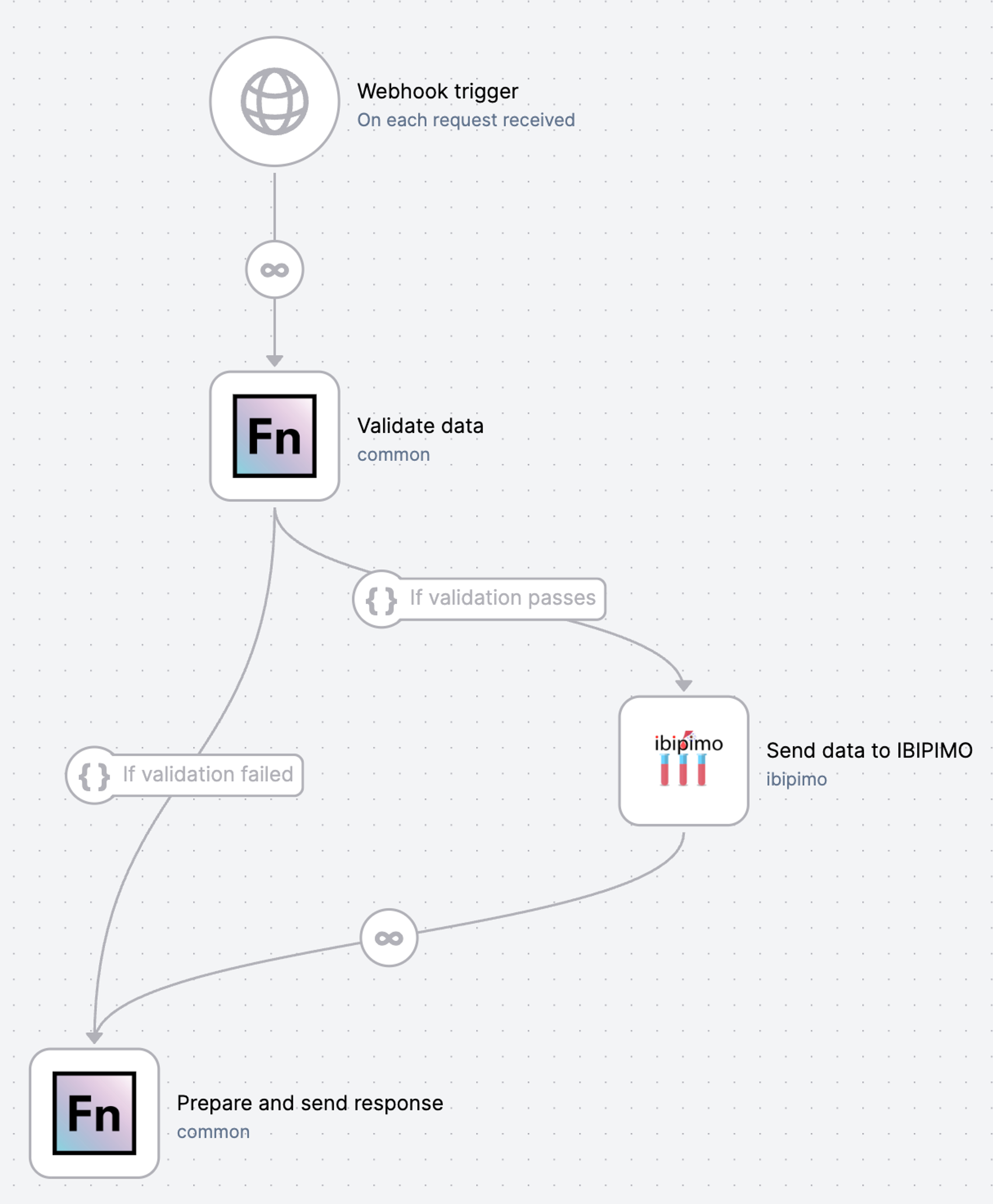
When a clinician orders a viral load test in SIDAInfo, OpenFn automatically submits the sample request to IBIPIMO. This passes patient demographics, ARV treatment history, and sample details to the lab without any manual re-entry. The workflow validates data before submission and returns a structured response to SIDAInfo confirming receipt.
IBIPIMO → SIDAInfo (Viral Load Results)
When results are ready in the laboratory system, OpenFn retrieves completed viral load results from IBIPIMO and delivers them back to SIDAInfo, giving clinicians the information they need to assess treatment response and adjust patient care. The workflow handles flexible field naming across system versions to ensure compatibility as the platforms evolve.
SIDAInfo → DHIS2 (Health Indicators)
On a scheduled basis, OpenFn aggregates HIV health indicator data from SIDAInfo and pushes it to DHIS2, supporting national-level monitoring and reporting. Health program managers can access timely, accurate data without waiting for manual data entry cycles.
All three workflows are triggered automatically – either by webhooks fired when clinical events occur, or on a regular schedule – and run validation checks before any data is transferred, ensuring that mistakes or typos are caught.
Built for Local Ownership
The production instance of OpenFn runs on a server hosted within Burundi, managed by MINISANTE. Keeping the infrastructure inside national systems was a deliberate design decision to ensure that the program isn’t dependent on external hosting and that sensitive patient data stays within the country’s own digital infrastructure.
Moreover, both MINISANTE and the Data.FI Burundi team have been fully trained on platform deployment, administration, and building new system integrations. This is crucial for fostering long-term ownership by the Ministry.
Dr. Olivier Musoni, Director of Health Sector IT Management (DGISSA) at MINISANTE, described the collaboration:
"OpenFn has demonstrated strong capability in designing scalable, production-ready health data interoperability solutions. Their platform is highly adaptable and their team has been professional, collaborative, and responsive throughout our engagement, working effectively with multiple stakeholders to build sustainable solutions that strengthen local capacity."
The Impact
For HIV program staff in Burundi, the practical effect is that the data infrastructure now keeps pace with the clinical work. Test requests reach the lab without a data entry step. Results return to clinicians faster. National reporting reflects what is actually happening in facilities.
Automation makes it possible for clinical and program staff to spend less time transferring data between systems, and more time using it.
Lessons Learned and Next Steps
Looking ahead, the collaboration between Data.FI, the Ministry of Health (MoH), and other partners will continue to expand, creating new opportunities for deeper engagement and sustainable business value.
The next phase of this work focuses on integrating the national Electronic Medical Records (EMR) system, OpenClinic, and the electronic Logistics Management Information System (eLMIS), Medexis. This phase will ensure a secure, phased approach toward achieving true end-to-end interoperability, strengthening the national health information systems architecture and reinforcing OpenFn’s role in supporting a unified, standards-based interoperability ecosystem.
If your organization is working on health system interoperability and is thinking about workflow automation, or view our list of partners to work with.

Written by
Justine Stewart