
Automating Social Services for the Dominican Republic's Proactive Services Initiative
The Dominican Republic is reimagining how social services reach families: instead of citizens chasing benefits, government systems now work together to deliver them proactively.
Imagine you're a mother in the Dominican Republic, receiving food subsidies that help your family get by. Then you give birth to another child. Instead of feeling excited, you’re worried about having another mouth to feed. Your family may qualify for more support, but the state won't know unless you tell it. You have to find the right office, bring the documents, wait, all while caring for a newborn. The frustrating part? The government already knows your baby was born. That information just lives in one system, while your subsidy lives in another.
Now imagine a different version. Your child is registered, as always. This time, that registration reaches the systems that manage social support. Your household updates on its own, and the extra benefit you now qualify for is set in motion. No office, no line, no chasing. The state sees that your family's needs have changed and responds.
That shift, from citizens chasing services to government delivering them, is exactly what the Dominican Republic's new National Strategy for Proactive Services is trying to achieve. On July 1, 2026, the government signed Decree 384-26, requiring public institutions to act on life events using data they already hold, and that may be lawfully shared under the governance framework established for the initiative, rather than waiting for citizens to ask.
The Ministry of Public Administration (MAP) is leading the strategy, working with government partners, including the Social Policy Coordination Cabinet (GCPS), the Single Registry of Beneficiaries (SIUBEN), and Supérate Social Development Directorate. They are joined by other partners, such as the United Nations Development Programme (UNDP), which brings extensive experience supporting the social protection system, and OpenFn as the technical partner contracted for joint implementation.
A first concrete step came through UNDP's Digital X 3.0 program, which funded a proof of concept: two prototype workflows designed to show what proactive service delivery could look like in practice, before scaling further.

The challenge: disconnected systems, delayed services
For years, citizens seeking access to social benefit programs have had to navigate complex, multi-institution processes that could be simplified if public entities were better connected. As Decree 384-26 recognizes, none of this changes without interoperability: without it, each institution continues to function as an island. It's a principle we've seen play out in other countries: systems stay disconnected, and the citizens end up doing the integration work themselves, carrying the same documents from office to office.
In the social protection system, this fragmentation has real consequences. Aliméntate (Feed Yourself), the Dominican Republic's principal cash transfer program, reaches over 1.4 million households. For families trying to access it, or to update their situation once enrolled, the process spans three separate institutions: a citizen submits an application through the Social Cabinet's citizen-facing Punto Solidario portal; SIUBEN receives the application and carries out an eligibility assessment; and Supérate manages benefit assignment and the delivery of cash transfers.
Because these systems were built separately, information does not always move between them as quickly or as seamlessly as it could. Today, for instance, information passes between the systems in scheduled batches, some running every 24 hours and others monthly, so a new application or a change in a household's situation may have to wait for the next transfer window before it moves forward.
Additionally, citizens often have limited visibility into where their request stands, and an update made in one place, such as a new phone number, may not reach the others. When contact details fall out of sync, people can miss the very calls or messages meant to move their case forward. The effect falls hardest on families: benefits they qualify for can arrive late, or not reach them at all, in a process that is slow and fragmented.
Designing automation through collaboration
MAP brought together technical and operational staff from the Social Cabinet, SIUBEN, and Supérate in a shared working space. These joint sessions surfaced pain points, documented existing data flows across institutions, and produced a co-designed vision of what an improved process could look like. OpenFn supported this effort by contributing technical input to translate what was learned into automation candidates for the proof of concept.
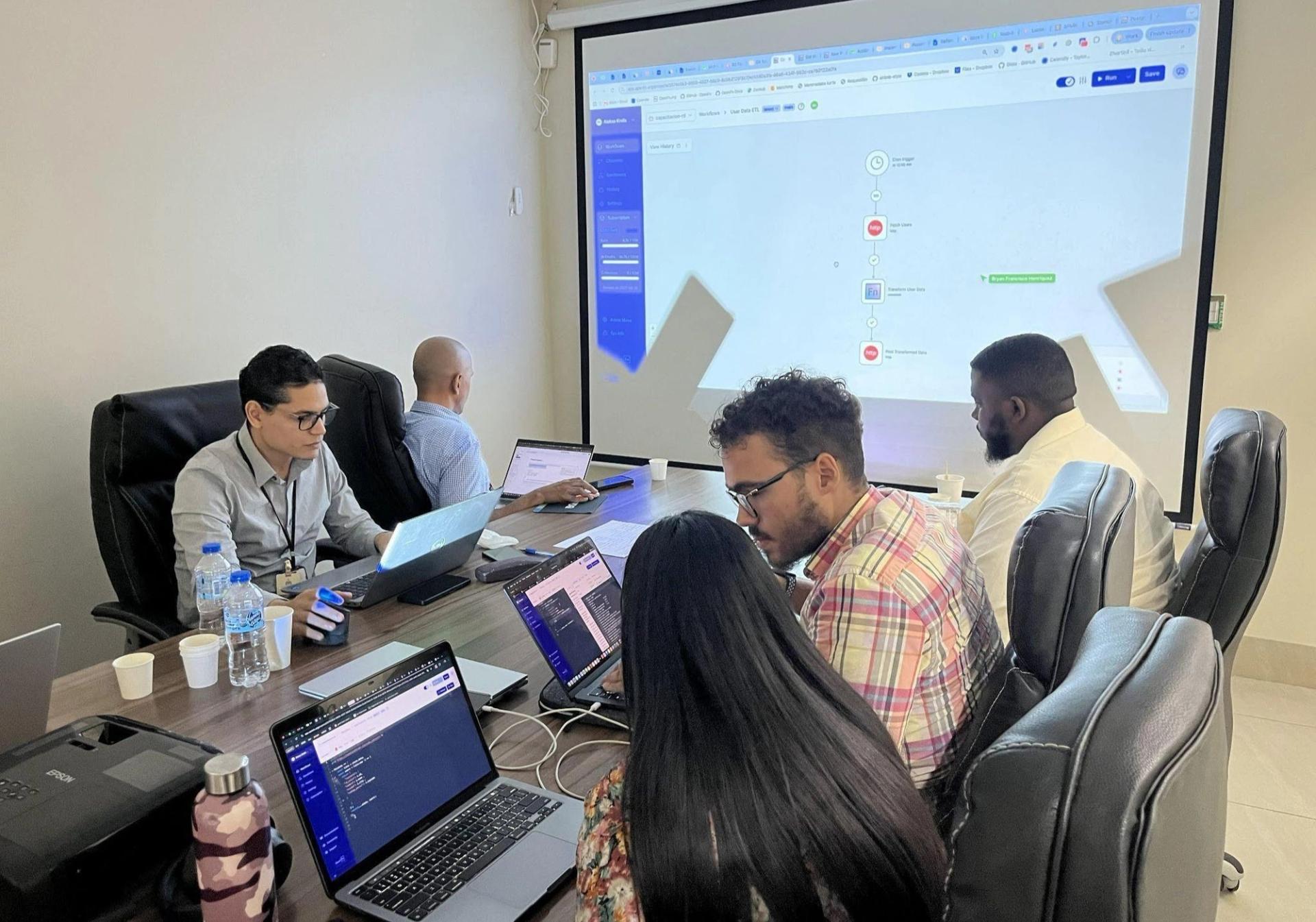
Ginsy Aguilera, one of the institutional leaders guiding this work, framed the aim during these sessions: the goal is not simply to automate, but to implement improvements that genuinely change the experience for citizens and bring the state closer to responding to their needs proactively.
This co-design process produced two priority prototype workflows.
How the automation will work
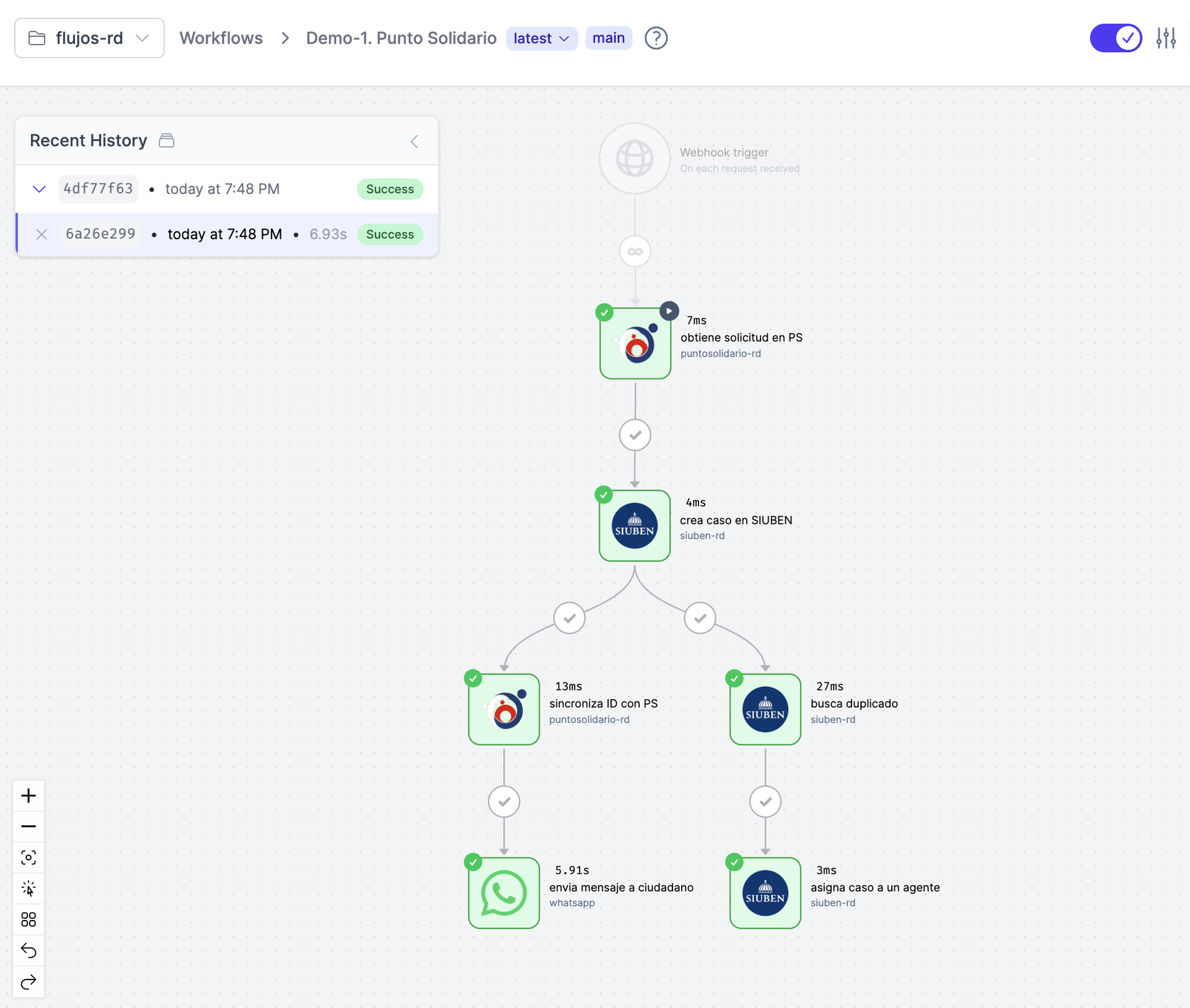
We helped design the first workflow to accelerate the handoff between citizen registration and case evaluation, enabling near-real-time data exchange between institutions rather than waiting for a scheduled batch window. It would also keep citizen contact information synchronized automatically across the different systems, reducing the risk of benefit delays or rejections caused by outdated records.
The second workflow is designed to close the notification gap that currently exists between institutions and citizens. When a household evaluation is completed, the workflow would sync updated statuses across the relevant systems, notify Supérate of newly eligible households, and send a notification to the citizen with their result and next steps. By keeping citizens informed automatically, it would also ease the volume of status inquiries reaching the program's contact centers.
Consistent with the principles established in the Proactive Services Strategy, both workflows are designed with human oversight built in: automated steps would handle data exchange and routing, while institutional staff retain responsibility for validation and decision-making at key points in the process.
Building capacity, not just technology
A core principle running through this engagement is that technology alone is not the goal. The workflows being developed are designed from the outset to be understood, maintained, and extended by in-country government teams. Training sessions with institutional staff are built into the scope, and the workflows themselves serve as reusable templates for future automation across social services and other sectors. By handling routine data exchange in the background, the automation lets program staff spend less time on manual coordination and more on the work that matters most: supporting the families they serve.
What's next
The workflows are being designed and configured by government teams, with OpenFn's support, and are built as reusable templates rather than one-off integrations. That means that as the Proactive Services Strategy rolls out across government, the same interoperability approach, proven on one of the country's largest social programs, can extend to additional benefit programs, other life events, new sectors such as health, and eventually many more government entities.

Written by
Emily Robinson